Home EV charger installation in Costa Blanca gives electric-car owners a safer, faster and more convenient way to charge at home — and, where solar is available, a smart charger can turn your own rooftop energy into vehicle fuel.
For many Costa Blanca homeowners, the ideal setup is not simply EV charger + electricity grid. It is EV charger + solar PV + smart energy management, with a battery added where it makes financial and technical sense.
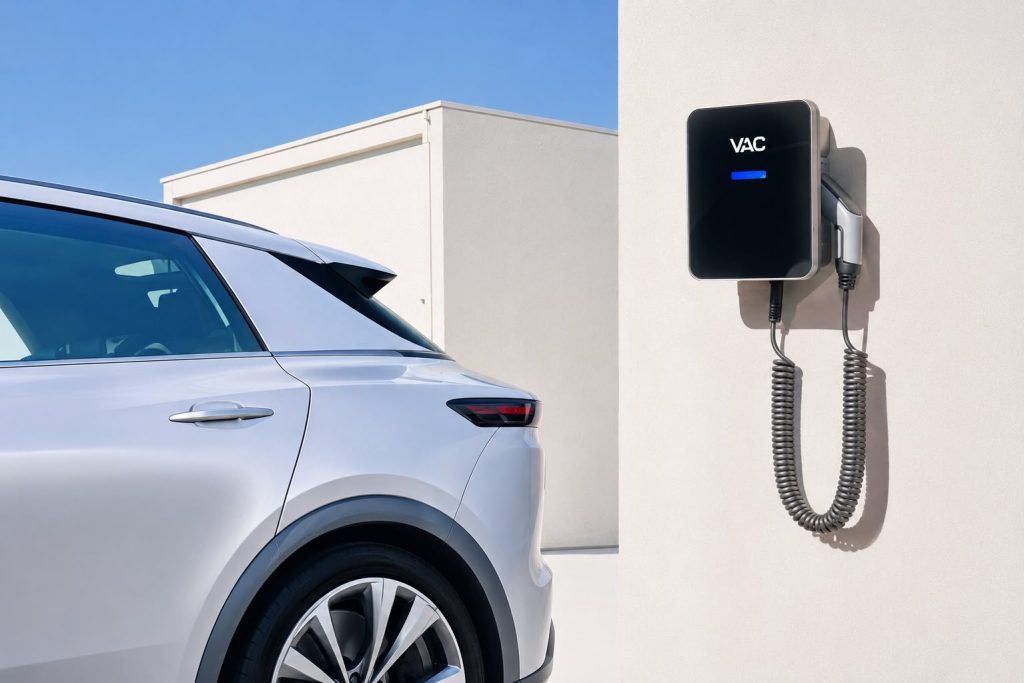
A dedicated wallbox is designed for regular high-power charging, unlike a standard domestic socket.
A properly designed installation can provide:
Convenient overnight charging
Faster charging than a conventional socket
Scheduled charging during cheaper tariff periods
Dynamic power management
Smartphone monitoring and control
Integration with solar panels and batteries
Better control of the home’s total electricity demand
The important point: the biggest charger is not necessarily the best charger. Your car, electrical supply, parking location and energy system should determine the specification.
Which Home EV Charger Is Best for a Costa Blanca Property?
7.4 kW Single-Phase Wallbox
For many villas, townhouses and apartments, 7.4 kW single-phase charging is a practical home solution.
It can provide substantial overnight charging without automatically requiring a three-phase supply.
11–22 kW Three-Phase Charger
If your property already has three-phase electricity, a higher-power charger may be appropriate.
However, the car itself must also support the relevant AC charging power. Installing a 22 kW wallbox does not mean every EV will charge at 22 kW.
Smart EV Charger
This is where things get more interesting.
A smart charger can monitor household consumption, schedule charging and, with suitable equipment, dynamically adjust charging power to avoid overloading the property.
For a modern Costa Blanca home, smart charging is often more valuable than simply buying the highest-power wallbox.
EV Charger + Solar Panels: The Smart Costa Blanca Combination
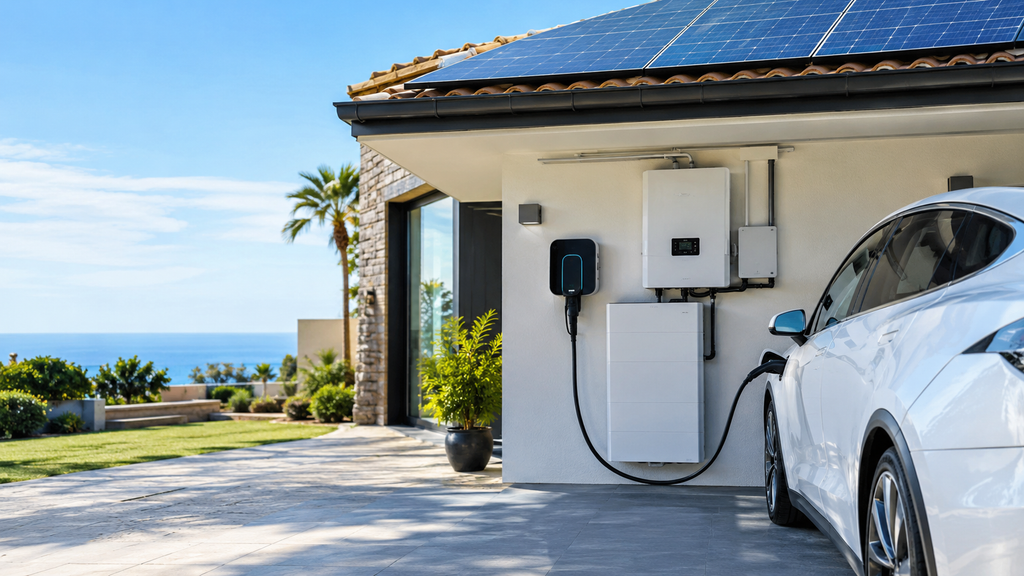
If your home has solar panels, your EV can become another major use for your solar production.
Instead of sending surplus photovoltaic energy to the grid, a compatible charger can use available solar generation to charge your vehicle.
Spanish regulations allow residential self-consumption arrangements, including systems with and without surplus export.
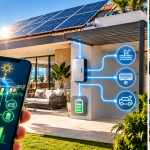
The ideal setup can look like this:
Solar panels → Home → EV charger → Electric car
And, where appropriate:
Solar panels → Battery → Home / EV charger
This makes particular sense for villas where the car is parked at home during sunny daytime hours.
What Type of Charger Works Best With Solar?
For solar charging, don’t simply look for a charger with a high kW rating.
Look for a smart EV charger with solar-surplus / photovoltaic integration and dynamic load management.
Ideally, it should be able to:
Monitor household consumption.
Detect available solar generation.
Adjust charging power automatically.
Prioritise household loads.
Use grid electricity when necessary.
Allow scheduled or controlled charging through an app.
This is particularly useful in Costa Blanca homes because strong daytime solar production can coincide with the vehicle being parked at home.
If you are installing solar and an EV charger together, design them as one energy system — not as two separate projects.
Best EV Chargers for Solar-Powered Homes
If your Costa Blanca home already has solar panels — or you are planning to install them — choose an EV charger designed to work with solar surplus rather than a basic wallbox.
Popular options include:
SolarEdge ONE EV Charger — particularly suitable for homes with a SolarEdge PV system.
Wallbox Pulsar Max / Pulsar Plus — smart charging with solar-surplus functionality and dynamic energy management.
Myenergi Zappi — specifically designed around solar-assisted EV charging.
Schneider EVlink Home Smart — a smart option for homes using the Schneider/Wiser energy ecosystem.
The key feature is not simply charging speed. Look for solar-surplus charging, dynamic load management and intelligent 1-phase/3-phase control. These features allow the EV to absorb excess solar generation without unnecessarily increasing grid consumption.
A home EV charger can be installed now and designed so that solar panels can be added later.
Alternatively, if you’re planning both projects, installing them together can make sense because the electrical architecture, energy management and consumption profile can be considered from the beginning.
At KwiCo Energy, we can assess both options: EV charger only or EV charging + solar energy system.
EV Charger Installation for Villas, Apartments & Communal Garages
The installation is not identical everywhere.
For a villa, the main questions are usually cable distance, electrical capacity, outdoor exposure and the location of the consumer unit.
For an apartment or communal garage, additional considerations can include:
Distance from the meter or electrical supply
Cable routing through common areas
Parking-space location
Building/community requirements
Electrical protection
Load management
Legalisation and certification requirements
So the correct approach is to assess the property before choosing the charger.
How Much Power Do You Actually Need?
More power is not automatically better.
A typical residential assessment should consider:
Factor
Why it matters
EV model
Determines maximum AC charging power
Daily mileage
Determines how much energy you actually need
Single/three-phase supply
Determines available charging options
Contracted power
Prevents excessive household load
Solar PV
Can reduce grid charging
Battery storage
Can provide additional flexibility
Cable distance
Influences installation complexity
Parking location
Determines installation requirements
A good installation gives you the right charging capacity without unnecessarily increasing the cost or electrical demand of the property.
Home EV Charger Installation Costa Blanca: What We Can Do
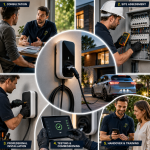
A professional installation can include:
EV charger supply + installation + dedicated electrical circuit + protection + load management + solar integration + system testing.
And if you don’t have solar yet, we can assess whether adding a solar PV system alongside your EV charger makes sense for your property.
The goal isn’t simply to put a box on the wall.
The goal is to create a charging system that works intelligently with your home.
FAQ: Home EV Charger Installation Costa Blanca
Can I charge my EV using solar panels?
Yes. With compatible equipment, a smart EV charger can use available solar production to charge the vehicle and increase self-consumption.
Is 7.4 kW enough for home charging?
For many households, yes. The correct power depends on the vehicle, daily driving and electrical installation. A higher-rated charger isn’t automatically necessary.
Do I need three-phase electricity?
No. Many residential EV installations use single-phase charging. Three-phase becomes relevant when higher charging power is required and supported by both the property and vehicle.
Can you install a charger if I don’t have solar?
Yes. The charger can also be designed with future solar integration in mind.
Can solar and an EV charger be installed together?
Yes — and this can be an excellent opportunity to design the property’s energy system as a whole rather than adding components separately.
Send us your EV model, property location and a photo of your electrical panel/parking area. We’ll assess the practical charging and solar options for your Costa Blanca home.