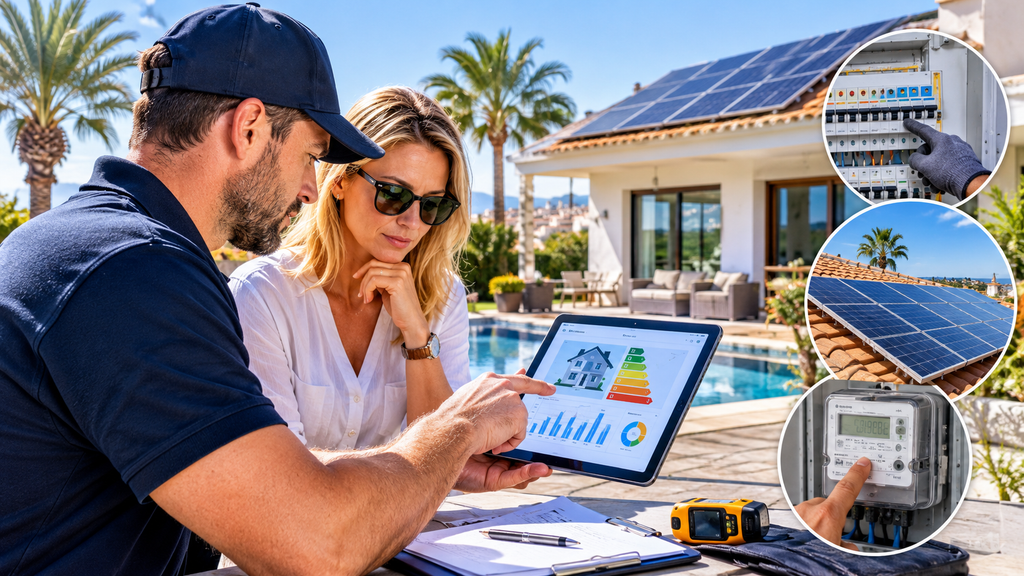
An Energy Audit in Torrevieja shows you where your property loses money on electricity and what to change first. Additionally, KWICO Energy analyzes your electricity bills and tariff. It reviews contracted power and your consumption pattern. If you have solar panels, it checks your inverter and system performance.
For businesses and homes on the Costa Blanca, savings come from three areas. These include using more of your own solar production. They also involve matching power to real demand and moving heavy loads to the right hours. Together, these practices maximize energy efficiency and reduce costs.
What Is an Energy Audit?
An energy audit is a structured review of how, when and why your property uses electricity, followed by a list of actions ranked by savings. It turns your bills and system data into clear answers: what you pay for, what you do not need, and what you can recover.
Practical Savings Audit vs Legal Energy Audit
The term covers two different things, and it is worth knowing which one you need.
- A practical energy savings audit is what most Torrevieja homeowners and small businesses need. It focuses on your tariff, contracted power, consumption profile and solar performance, with the goal of lowering your bill.
- A legal energy audit is a formal obligation under Spanish Royal Decree 56/2016 for large companies, meaning those that are not SMEs under the EU definition. It must be carried out by qualified energy auditors, repeated every four years, cover at least 85% of the company’s energy consumption and be reported to the regional authority. Large companies can alternatively implement an energy management system.
Most local businesses (restaurants, shops, small hotels, offices, workshops) are SMEs and are not covered by that obligation, but they still benefit from the practical audit. If you think your company may be a large one, confirm your status with your adviser before relying on any audit as a legal one.
Why Torrevieja and the Costa Blanca Need a Different Kind of Audit
The Costa Blanca has strong sunshine for most of the year, which makes solar attractive. It also creates a specific problem. Solar production peaks around midday, while many holiday homes are empty and many businesses have their heaviest demand in the evening. Surplus that you do not use is exported and compensated at a low rate, while electricity bought later is far more expensive. On a typical home or business contract the gap can be large, often in the region of €0.04 per kWh for surplus against €0.20 per kWh or more for purchased energy, although your own figures depend on your supplier and contract.
Local conditions add further load patterns: pool pumps running for hours, air conditioning in long summers, EV chargers, hot water boilers, and seasonal occupancy. A generic audit written for a northern European climate misses these. An audit built around Costa Blanca usage looks at them directly.
What We Check in Your Energy Audit
1. Your Electricity Bills and Tariff
We review your supplier bills from Iberdrola, Endesa, or others. We check energy price, the power term, taxes, and extra charges. In Energy Audit in Torrevieja, we identify cost drivers and savings.
We check which access tariff applies to you. In Spain, low voltage up to 15 kW uses 2.0TD. Above 15 kW, low voltage uses 3.0TD. High voltage uses 6.xTD tariffs. Each tariff has different time periods and rules. The right optimisation depends on which one you are on.
2. Contracted Power (Potencia Contratada)
Contracted power is a fixed charge you pay whether you use it or not. If it is higher than you need, you pay for capacity that sits idle. If it is too low, you risk tripping the main switch or, on larger supplies, excess power charges. On the 2.0TD tariff you can contract different power for peak (punta) and off-peak (valle) periods, and the regulator’s own guidance points out that moving power from the peak period to the off-peak period can reduce the bill. We compare your contracted power with your real demand and recommend the right level.
3. Your Consumption Pattern and Time Periods
Spanish tariffs price electricity by time period. On the 2.0TD tariff, weekday energy is split into punta (10:00 to 14:00 and 18:00 to 22:00), llano (08:00 to 10:00, 14:00 to 18:00 and 22:00 to 24:00) and valle (00:00 to 08:00, plus all weekends and national holidays). The 3.0TD and 6.xTD tariffs use six periods. We map your consumption against these periods and identify what can move to cheaper hours.
4. Your Solar System and Inverter
If you already have solar panels, we look at how much of your production you consume directly, how much you export, and whether your inverter settings are costing you money. We work with Huawei, Fronius, Solax, Victron and Shelly systems.
5. Surplus Compensation
Under Spain’s simplified surplus compensation scheme, renewable installations up to 100 kW can have their exported energy credited on the monthly bill. The credit cannot exceed the value of the energy you consumed in that billing period, and it applies to the energy term only, not to the fixed power term. That means exporting a lot of surplus rarely pays as well as using it yourself, which is why self-consumption is the focus of the audit.
6. Heavy Loads: Pool, Air Conditioning, Hot Water and EV Charging
We identify the loads that can run during sunny hours instead of at night: pool filtration, boilers, pre-cooling, and electric vehicle charging. These are often the quickest wins, because they shift consumption without reducing comfort.
7. Battery Storage
We assess whether a battery makes financial sense for you or whether load shifting alone gives most of the benefit. A battery is not required to start saving.
What You Get From the Audit
- A clear picture of where your electricity money goes
- An assessment of your tariff and contracted power
- An analysis of how much of your solar production you use and how much you lose
- A prioritised list of actions, starting with those that need the least investment
- Honest advice on whether smart energy management, an upgrade or a battery is worth it for your situation
Energy Audits for Businesses in Torrevieja and Alicante Province
Businesses with daytime activity are well placed to benefit from solar, because their demand overlaps with production. The audit is relevant to:
- Restaurants and bars: kitchen equipment, refrigeration and air conditioning create high, predictable loads.
- Hotels, apartments and holiday rentals: occupancy swings make load control and contracted power especially important.
- Shops and offices: lighting, climate control and equipment run during sunny hours.
- Workshops and small industry: three-phase equipment and peak demand often drive the power charges.
Energy Audits for Homes, Villas and Holiday Homes
For homeowners, the audit answers a simple question: is my solar system saving what it should? Many villas with panels still pay high bills because the pool, boiler and air conditioning run when the sun is down, and surplus is exported at a low rate. For holiday homes and second residences, we also look at standby consumption while you are away and options such as pre-cooling before you arrive.
How the Energy Audit Works
- Send your information. Share recent electricity bills and, if you have solar, your inverter brand and model.
- We analyse. We review tariff, contracted power, consumption periods and solar performance.
- We explain the results. You see where you lose money and which actions give the best return.
- You decide. You can act on the recommendations yourself or ask us to implement them, including smart energy management for solar homes.
Frequently Asked Questions About Energy Audits in Torrevieja
What is an energy audit and who needs one?
An energy audit is a review of how a property uses electricity, with recommendations to reduce cost. Any home or business with high bills, a solar system that is not delivering the expected savings, or a contract that has not been reviewed for years can benefit from one.
Is an energy audit mandatory in Spain?
For large companies, yes. Royal Decree 56/2016 requires companies that are not SMEs to carry out an energy audit every four years, or to adopt an energy management system. Homes, small businesses and most SMEs are not legally required to do so, but can use a practical audit to reduce costs.
What documents do I need to start?
Your latest electricity bills are the main requirement. If you have solar panels, tell us the inverter brand and model so we can check how it is configured.
Can an audit lower my contracted power?
Often it can identify that your contracted power is higher than your real demand. Lowering it reduces the fixed monthly charge, but it must be done carefully so that you do not trip the main switch or incur excess charges.
Do I need solar panels to benefit from an audit?
No. Tariff selection, contracted power and consumption timing apply to any property. If you do not have solar, the audit can also show whether solar would make financial sense for your usage.
Do I need a battery?
No. Most of the benefit comes from using your solar production directly during the day. A battery can be added later if the numbers support it.
Which areas do you cover?
KWICO Energy is based in Torrevieja and works across the Costa Blanca, including Orihuela Costa, Pilar de la Horadada, Guardamar del Segura, Rojales and Ciudad Quesada, Santa Pola and Alicante.
How much can I save?
Savings depend on your tariff, contracted power, usage pattern and solar system, so no honest figure can be given without your data. The audit puts a number on it for your property before you spend anything on equipment.
Request Your Energy Audit in Torrevieja
If your electricity bills are high, your solar panels are not saving what you expected, or you have never reviewed your contract and contracted power, an energy audit is the right first step.
Related services:
- Smart home energy management ·
- Solar panel installation ·
- Solar system upgrades ·
- EV charger installation ·
- Commercial solar systems