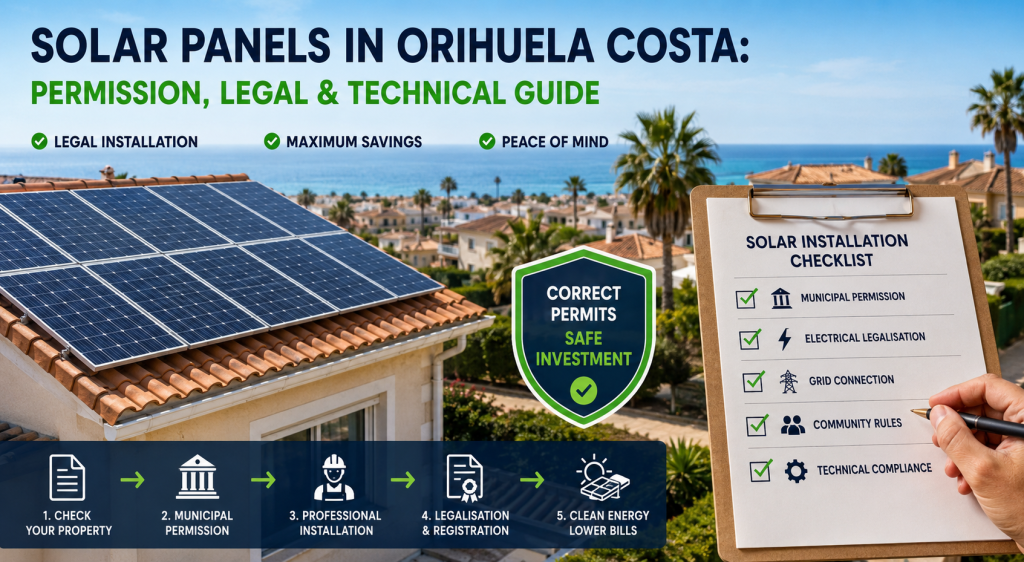
Yes, in most cases you need to complete a municipal urban-planning procedure before or in connection with installing solar panels in Orihuela Costa — but this does not necessarily mean obtaining a traditional building licence. For a typical residential rooftop photovoltaic installation, the applicable procedure may be a Declaración Responsable de Obra or another municipal works procedure, depending on the property, installation design and planning conditions.
You also need to legally commission and register the photovoltaic installation under Valencian and Spanish electrical regulations. These are two separate issues: municipal planning compliance is not the same as electrical legalisation.
For a standard villa in areas such as La Zenia, Playa Flamenca, Cabo Roig, Campoamor, Villamartín or Los Dolses, the process is normally much simpler than for a large commercial system, a ground-mounted installation or a property in a protected area.
Do solar panels require a licence in Orihuela Costa?
The important distinction is between planning permission and a traditional licence de obra.
Orihuela has a municipal procedure for minor works in urban land through a Declaración Responsable, and the Ayuntamiento’s current documentation distinguishes this from other types of urban-planning authorisation.
Therefore, a typical rooftop solar installation should not simply be installed without checking with Urbanismo because the panels are considered an electrical installation. The roof alteration is also a building/planning matter.
The practical answer
For a normal residential solar installation:
Roof-mounted panels + existing legal dwelling + urbanised plot → usually a simplified municipal works procedure rather than a major building licence.
However, the exact procedure can change if the installation:
alters the building structure;
requires significant structural reinforcement;
creates a new supporting structure;
is installed on a pergola or carport;
is ground-mounted;
is located on protected property;
is in a special planning zone;
is on non-urbanisable/rustic land;
affects communal elements of a residential development;
or involves a large commercial installation.
Do not confuse “usually no traditional licence” with “no permission required.”
What permissions do I need for solar panels in Orihuela Costa?
There are effectively three separate compliance layers.
Requirement
Who deals with it?
Typical residential system
Urban-planning/works procedure
Ayuntamiento de Orihuela
Usually required
Electrical legalisation
Generalitat Valenciana / authorised installer
Required
Grid/export procedure
Distributor, where applicable
Depends on system
This is why a professional solar installation should be treated as a legalised construction + electrical project, not simply a panel installation.
1. Municipal permission from Orihuela Ayuntamiento
The first question is whether the proposed installation complies with the property’s planning status.
For a standard villa in Orihuela Costa, the installer or technical professional should check:
property location;
cadastral reference;
planning classification;
existing building legality;
roof configuration;
panel arrangement;
visual impact;
structural implications;
setbacks where applicable;
whether the property is subject to special protection.
The Ayuntamiento of Orihuela provides urban-planning documentation and procedures through its municipal channels.
Declaración Responsable vs licence
A Declaración Responsable is not simply a formality saying “I am installing solar panels.”
It is a legal declaration that the proposed work complies with the applicable requirements and that the required documentation is available.
Orihuela’s documentation includes a specific Declaración Responsable para la Ejecución de Obras Menores en Suelo Urbano, illustrating the municipality’s framework for minor urban works.
For installations falling outside that simplified category, a licencia urbanística or additional technical authorisation may be necessary.
Do I need planning permission for solar panels on a villa in Orihuela Costa?
Usually, yes, you need to complete the applicable municipal works procedure, but a conventional rooftop system will often fall within a simplified route rather than requiring a major building licence.
The critical point is the specific property and installation, not simply the number of solar panels.
A 5 kWp system installed flush on an existing villa roof is very different from a 20 kWp system on a new steel structure in the garden.
Do I need permission for solar panels on a townhouse?
Potentially — and there is an additional issue.
A townhouse may form part of a Comunidad de Propietarios, meaning the roof, façade or other areas may be communal rather than privately owned.
Before installation, check:
Who legally owns the roof?
Is the roof a private element or common element?
Does the installation affect the façade?
Will cables or equipment cross communal areas?
Does the installation require access through communal property?
Do the community statutes contain restrictions?
Your property title and community rules matter as much as the solar design.
Can a Comunidad de Propietarios stop me installing solar panels?
Not automatically.
Spanish horizontal-property legislation provides a framework for renewable-energy installations and collective or individual self-consumption. The exact voting requirements depend on the type of installation and how communal elements are affected.
For this reason, an apartment owner should not order installation first and ask the community later.
For a detached villa with no community involvement, this issue is generally much simpler.
Do I need permission for solar panels with a battery?
The battery does not eliminate the permitting requirements.
A battery-storage system introduces additional electrical equipment and must comply with the applicable low-voltage electrical regulations.
The installer should verify:
battery location;
ventilation and manufacturer requirements;
electrical protection;
inverter compatibility;
cable sizing;
isolation and protection;
fire-safety considerations where applicable;
indoor/outdoor installation requirements;
integration with the photovoltaic system.
A battery can also change the technical configuration of the system, so it should be included in the electrical documentation from the beginning.
Do I need permission if the solar system is off-grid?
Off-grid does not mean regulation-free.
A completely independent solar installation may avoid some grid-connection procedures, but it can still be subject to:
municipal planning rules;
building regulations;
electrical safety requirements;
structural requirements;
environmental restrictions;
protected-area rules.
An off-grid system mounted on a villa roof is still physically attached to a building.
An off-grid solar structure installed on undeveloped or rustic land can be a completely different planning case.
Do I need permission for ground-mounted solar panels in Orihuela Costa?
Ground-mounted systems require much more careful planning analysis than standard rooftop panels.
The critical distinction is whether the panels are:
on an existing building;
on a permitted structure;
on a carport/pergola;
or installed as a new independent structure on the land.
For rustic or non-urbanisable land, additional planning restrictions can apply.
Never assume that because a rooftop installation is straightforward, a garden or plot installation is equally simple.
What about solar pergolas and carports?
This is one of the biggest legal grey areas for homeowners.
A solar pergola is not necessarily treated like ordinary roof-mounted panels.
If you are constructing:
a new pergola;
a carport;
a covered terrace;
a steel solar canopy;
or another independent supporting structure,
the municipality may assess the structure itself, not just the photovoltaic equipment.
The correct question is therefore:
“Is my solar installation merely equipment on an existing roof, or am I creating a new construction?”
That distinction can change the planning procedure.
What if my house is in a protected area?
Then the answer can change significantly.
Properties affected by heritage protection, BIC status, historic environments or protected surroundings may require additional authorisation.
The Generalitat Valenciana states that interventions affecting BIC properties or their protected surroundings can require authorisation from the competent cultural authority before the municipality can grant the corresponding planning authorisation.
This is particularly important in historic parts of Orihuela and for properties subject to special protection.
For a normal modern villa in Orihuela Costa, this is usually not the main issue — but the property’s planning status should always be checked before installation.
Do solar panels need to be registered in Valencia?
Yes.
Municipal permission and electrical registration are separate procedures.
The Generalitat Valenciana has specific procedures for photovoltaic self-consumption installations connected at low voltage.
For installations up to 10 kW, there is a dedicated procedure for communicating commissioning, modifications and registration of the associated self-consumption installation.
For installations above 10 kW, the Generalitat requires a different procedure and technical documentation.
What documents are needed to legalise solar panels?
The exact documentation depends on the system, but professional installations typically involve:
electrical installation certificate;
technical documentation;
photovoltaic system specifications;
inverter documentation;
self-consumption registration;
CAU (Código de Autoconsumo);
technical project where required;
certificate of completion where applicable;
anti-islanding/anti-export documentation where applicable;
grid documentation where required.
For systems above 10 kW, the Generalitat specifically requires technical documentation including a technical project and, where applicable, a certificate of direction and completion of works.
Do I need permission from the electricity company?
Not necessarily.
This depends on the self-consumption configuration.
Under Spain’s self-consumption regulations, self-consumption without surplus is exempt from generation access and connection permits.
For installations with surplus, systems of up to 15 kW located on urbanised land meeting the required conditions are also generally exempt from generation access and connection permits.
That does not mean the installation can skip legalisation.
It simply means that a separate generation access/connection permission may not be necessary.
Can I sell or receive compensation for excess solar electricity?
Yes, depending on the chosen self-consumption arrangement.
The Spanish self-consumption framework allows compensation for surplus electricity, subject to the applicable requirements and contract arrangements.
For a typical home in Orihuela Costa, the common approach is:
A battery can reduce the amount of electricity exported by storing excess generation for later use.
Is a technical project required for a home solar installation?
Not automatically.
The technical documentation depends on the installation’s characteristics and applicable electrical regulations.
The Valencian administration distinguishes between installations requiring a technical project and those that can be processed with the appropriate installation documentation.
For residential photovoltaic installations up to 10 kW, the Generalitat has a dedicated low-voltage self-consumption procedure.
For installations above 10 kW, the Generalitat’s procedure explicitly requires a technical project signed by a competent qualified professional.
What technical requirements must solar panels meet?
A legal installation is much more than panels attached to a roof.
The system should be designed according to the applicable Reglamento Electrotécnico para Baja Tensión (REBT) and photovoltaic requirements.
The design should address:
Roof structure
The installer should verify that the roof can safely support:
panel weight;
mounting system;
wind loads;
maintenance loads;
additional equipment.
Wind resistance
This is especially relevant on the Costa Blanca.
Panels must be mechanically secured against local wind conditions rather than simply weighted or loosely mounted.
Electrical protection
The system requires appropriate:
DC protection;
AC protection;
isolation;
overcurrent protection;
surge protection where required;
earthing;
cable protection.
Inverter
The inverter must comply with the applicable technical requirements and grid protection standards.
Anti-islanding protection
Grid-connected systems must prevent inappropriate energisation of the network during grid outages.
The Valencian registration procedure specifically requires evidence of compliance for applicable photovoltaic inverter and anti-islanding requirements.
Can I install solar panels myself?
Technically, panels can look deceptively simple.
Legally and electrically, however, a grid-connected photovoltaic installation is not a DIY plug-and-play project.
The Valencian registration procedures require the relevant commissioning documentation to be submitted through an authorised electrical installer for the applicable self-consumption installations.
For a legally registered system, the important question is not merely:
“Can someone physically put panels on my roof?”
It is:
“Can the complete installation be correctly designed, certified, commissioned and registered?”
What happens if I install solar panels without permission?
There are two separate risks.
Urban-planning risk
The Ayuntamiento can investigate works carried out without the required planning title.
Orihuela actively exercises urban-planning control, and the municipality has previously reported enforcement action against works carried out without the necessary licence.
Electrical/legalisation risk
An unregistered photovoltaic installation can create problems with:
grid connection;
surplus compensation;
insurance;
property sale;
future inspections;
system modifications;
proving compliance.
Saving a little on paperwork can become an expensive problem when selling the house.
Does installing solar panels affect my house insurance?
Potentially.
Insurance policies vary, but insurers may require electrical installations to be legally compliant and professionally installed.
A properly documented system gives you a much stronger position if there is ever a dispute involving:
fire;
electrical damage;
storm damage;
roof damage;
inverter failure.
Keep the complete installation file rather than just the invoice.
What should I receive from my solar installer?
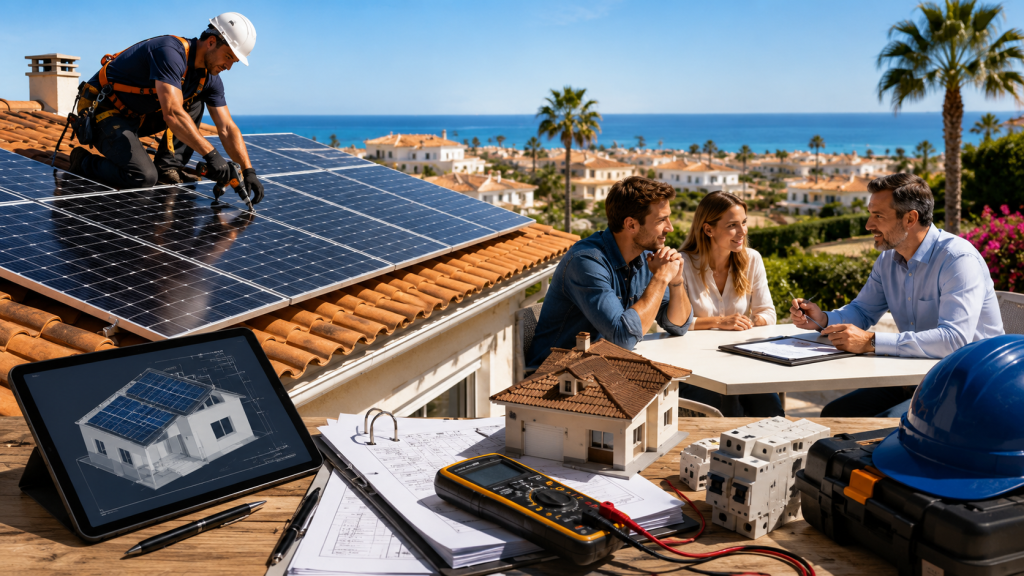
A professional installer should be able to explain the entire legal process before work starts.
Ask for:
system design;
panel and inverter specifications;
structural assessment where necessary;
electrical documentation;
municipal works documentation;
installation certificate;
self-consumption registration;
CAU;
distributor documentation where applicable;
warranty documentation;
commissioning report;
monitoring-system access;
battery documentation if applicable.
The golden rule
Never accept “the installer takes care of everything” as the only answer.
Ask:
“Will you provide proof that the installation has been legally registered and commissioned?”
That single question separates a properly documented installation from a roof full of expensive hardware.
How long does solar permission take in Orihuela Costa?
There is no single universal timeframe because the process depends on the municipal procedure, technical complexity and whether additional authorisations are required.
A straightforward residential system can be considerably simpler than:
a large commercial installation;
a ground-mounted system;
a solar carport;
a protected property;
a system requiring structural work.
The fastest route is usually achieved when the installer identifies the correct planning procedure before ordering equipment.
What about IBI or other solar incentives in Orihuela?
This should be checked separately from the permission question.
Municipal incentives can change, and eligibility may depend on:
property type;
installation characteristics;
documentation;
application deadlines;
current municipal tax ordinances.
Do not base your solar ROI calculation on an assumed IBI discount without checking the current Orihuela rules for the year in which you install the system.
Orihuela Costa solar installation checklist
Before installing solar panels, check these 10 points:
Is the property legally registered and compliant?
What is the property’s planning classification?
Is the roof private or communal?
Does the installation require a Declaración Responsable or licence?
Does the roof require structural verification?
Is the system under or over 10 kW?
Will it export electricity to the grid?
Is a battery being installed?
Does the property have any heritage/protection restrictions?
Will the installer complete the Generalitat electrical registration?
If all ten questions have clear answers, the installation is normally on solid legal and technical ground.
Do I need permission to install solar panels in Orihuela Costa? — Bottom line
Yes — expect to complete a municipal planning/works procedure, but a standard residential rooftop installation does not necessarily require a traditional building licence.
For most ordinary villas, the process is essentially:
1. Property and planning check → 2. Municipal works procedure → 3. Professional solar design → 4. Installation → 5. Electrical certification → 6. Generalitat self-consumption registration → 7. Distributor/energy-contract procedures where applicable.
The exact route depends on where the panels are installed, what structure they are mounted on, the property’s planning status, system power and whether communal or protected property is involved.
For a typical villa in Orihuela Costa, the smartest approach is therefore not to ask only “Do I need a licence?” but:
“What municipal planning procedure applies to my specific solar installation, and will the system be fully legalised after commissioning?”
That is the question that prevents expensive surprises later.
Legal note: Spanish, Valencian and municipal rules can change, and individual properties may have additional planning restrictions. This guide is an expert-oriented practical overview, not a substitute for a property-specific determination by Orihuela Urbanismo or a qualified Spanish technical professional.